


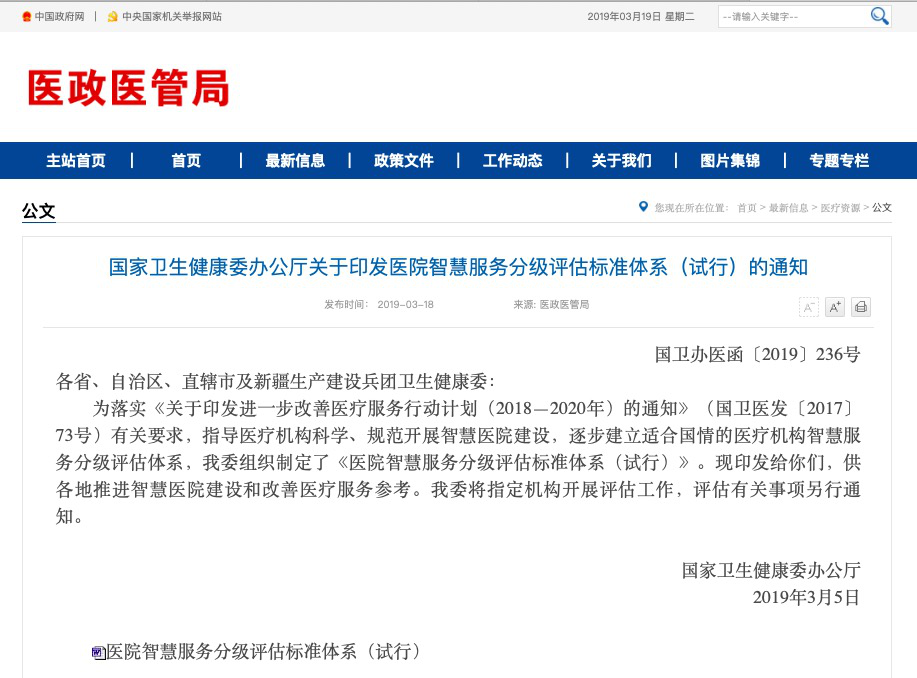
The trial notice of the "Hospital Smart Service Grading Evaluation Standard System" was released in 2019, guided by standards, aiming to guide medical institutions to carry out the construction of smart hospitals in a scientific and standardized manner, and gradually establish a medical institution smart service grading evaluation system suitable for national conditions. Continuously strengthening the informationization construction of hospitals and providing intelligent services is a foundation for further establishing smart hospitals and an important part of smart hospital construction
After understanding the importance of building smart hospital services, what other requirements do we need to know in the evaluation criteria?
Firstly, we must know what each level represents:
Level 0: Hospitals have little or no use of information technology to serve patients
Level 1: Hospitals use information technology to provide partial services to outpatient or inpatient patients
Level 2: Initial establishment of intelligent services within the hospital
Level 3: Initial establishment of intelligent services connecting internal and external hospitals
Level 4: Basic establishment of hospital intelligent services
Level 5: Basic establishment of intelligent medical and health services based on hospitals
Then we need to understand how the level is evaluated?
The grading evaluation of hospital smart services adopts a quantitative scoring and overall grading approach.
Quantitative scoring is an evaluation of medical business information systems in various aspects of hospitals, consisting of 5 categories and 17 evaluation items.
The five categories are: pre diagnosis services, during diagnosis services, post diagnosis services, full process services, basic and safety services;
The 17 items are: diagnosis and treatment appointment, first aid connection, referral service, information push, identification and navigation, patient convenience guarantee service, patient feedback, patient management, drug dispensing and distribution, family service, primary physician guidance, expense payment, intelligent guidance, health education, remote medical care, safety management, and service supervision.
Individual project comprehensive score=functional score x effective application scope score
The functional rating refers to determining the score of each evaluation item based on the functional requirements and evaluation content corresponding to each evaluation item at levels 0-5, in order to achieve the functional status of the corresponding evaluation item;
The effective application scope score refers to the actual application proportion of the project in hospitals.
The overall grading is evaluated based on the total score, completion status of basic projects, and selection of project completion status.
The total score refers to the sum of various scores for local application situations, and is not lower than the minimum total score standard for the corresponding level;
The completion status of basic projects refers to: all basic projects specified in the corresponding level have met the standards, and some projects have an application scope of over 80%;
The selection of project completion status refers to: at least 50% of the selected projects at the corresponding level meet the standards, and some projects have an application scope of more than 50%.
That is to say, the 17 projects mentioned above have different requirements for meeting different levels of standards. Low level projects may have lower requirements or exist in the selection of projects that are not mandatory to complete, while high-level projects may have higher requirements and are necessary to complete.
Based on the evaluation criteria of the above levels, it is not difficult to find that the evaluated items indeed cover all aspects of the entire medical process, and provide guidance for hospitals on how to improve service quality and enhance service intelligence. In addition to functional requirements, requirements have also been put forward for the promotion and use of these smart services. The improvement of these services is not only about "upgrading", but also requires guiding residents to use them. Only by putting it into practice can we truly improve!